
I think one of the more impressive things the FMA 03 did was get me to care about Lust while simultaneously making her an unrepentant killer.
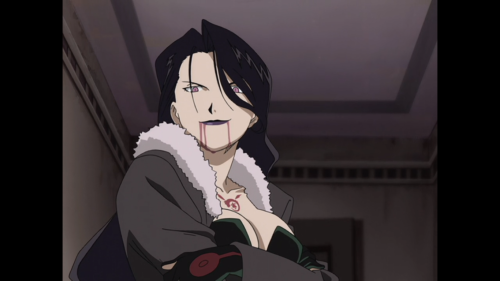
I think one of the more impressive things the FMA 03 did was get me to care about Lust while simultaneously making her an unrepentant killer.

So there’s this popular definition of calling filler episodes any episode which deviates from the manga. (In a manga-based anime.)
I can see why this might be useful, as sometimes episodes are created purely to fill space or kill time if they have an episode count to meet or are waiting for more manga chapters to be released. These episodes can generally just be skipped and the viewer won’t miss anything of importance.
It’s kind of irritating to use this term to attempt to describe something like the Fullmetal Alchemist anime however. It’s based on a manga, sure, but it’s not attempting to stay true to it. It’s telling its own story and didn’t instead try to waste time by throwing in loads of filler episodes.
It’s not canon to the manga but it’s own separate story and therefore its own separate canon. (Besides it was the manga that deviated from 03, the 03 story finished long before the manga did… I’m kidding.)
Anyway, I define filler as skippable content which basically means any episode you can entirely skip without missing out on anything. These are usually self-contained stories with a filler villain who is introduced and defeated inside of one episode and filler characters who never appear again. No actual progress in the series-wide plot is made in a filler episode.
So, what filler does the Fullmetal alchemist anime have?
Continue reading “Filler”Okay, I thought I’d do a post about Father’s in FMA 03 like I did with Mother’s in this post and…

Ha, Ha, Ha. Fathers are terrible in FMA, aren’t they? There’s like one bright spot. I will be speaking mainly about fathers in regards to the Elric brothers.
Regardless…
I’ll start with episode 1. We’re introduced to someone called Father Cornello. Of course, it’s a title to indicate that he’s a holy man rather than seriously meaning a paternal figure. If it is in any way an intentional theme (given he does want to present himself as a caring man who can take care of Liore) well soon enough his true nature as a fraud who’s really interested in power is revealed.
His falseness can be contrasted with Rose who is later given the title Holy Mother – she didn’t seek the title herself and her care for Liore and its people is genuine. Where Cornello makes great speeches full of lies, Rose is mute and yet honest in her intentions. But I digress.

Moving on, Ed and Al do not have a father. Their father abandoned them at a young age and all they remember of him is his absence. Likewise, both of Winry’s parent’s are dead and they grow up without any sort of father figure. I like the phrasing of the dub here. “I wouldn’t say I hate him, I don’t remember him enough.”
With the death of their mother this morphs into a firmer dislike from Edward (Alphonse still wants to know their absent father). Despite their father’s absence they take after him, learning alchemy from his books including the forbidden stuff. Their attitude can be contrasted with the Tringham brothers in episode 11-12 where their father is dead and they’re learning alchemy in honour of his memory and to be like him. It’s why they’re so motivated to save Xenotime such that they’re convinced to use insidious methods. Ed meanwhile hates to be compared to his absent father.

The one exception to the absent or terrible fathers is, of course, Maes Hughes who seems to genuinely care for the brothers. He helps them for no other reason than that he cares for them. He is great. He throws Edward a little birthday party, sits and talks with him at meals, gives him help and advice, sends Armstrong to tail them as protection. They have a great relationship.
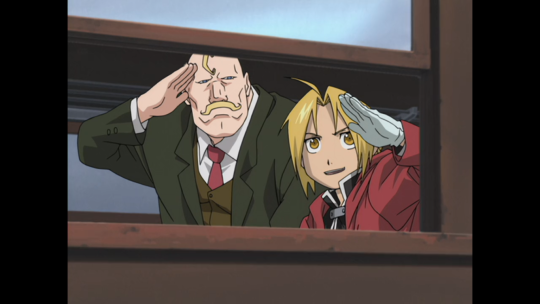
In the above scene, Hughes decides to tell Ed that Scar was responsible for Nina’s death rather than deciding to keep the information from him. Even when Maria Ross suggests its too dangerous for the Elrics to continue searching for the stone, Hughes continues to enable them while giving them protection as he knows that otherwise the boys would just strike out on their own. Edward in turn opens up to Hughes, deciding to tell him about the homunculi behind Lab 5. Obviously, he is not just fatherly towards the Elrics but dotes on his own daughter and loves his wife. So of course the homunculi kill him.

Hughes great family can be contrasted with Shou Tucker and his daughter. Tucker welcomes the Elrics into his home and soon becomes sort of like a father to them, providing them support and a home while they prepare to join the military. He’s kind and offers them advice where he can, even recommending they stay away from the military. He seems to love his daughter Nina too. But just like with Father Cornello, it’s all a facade. Just as Cornello made chimeras that sounded like real people to maintain his illusion of power and respect, Tucker turns people into chimeras in order to keep hold of his life as a respected State Alchemist.
Tucker turns Nina into a monstrous chimera in some misguided attempt to retain his old lifestyle showing that at his core he is awful and selfish. Just like that, Ed and Al’s replacement home has been destroyed as thoroughly as their initial home. And it was a home for them. That’s partly why the reveal shakes them so much. Their worst fears confirmed in the worst possible way.

I guess they do still have Sig Curtis. I mean, they’ve been avoiding him and Izumi for years but when they are with him its okay. He’s nice and cares for the boys though he’s ultimately a pretty quiet person who tends to follow his wife, Izumi’s lead. Maybe he could be a good father but we never see any moments of the Elrics bonding and looking to him for advice unlike Hughes or Tucker. We never see him show any care towards Wrath in the series either. Mostly he’s just there for Izumi.

I haven’t mentioned Mustang, have I? That’s because he an absolutely terrible father figure as well. He does care for the Elrics but that’s really not enough. Upon seeing an unconscious crippled 11 year old Edward, he… recommends they join the military. Yeah. Become a child soldier and leave what’s left of your childhood behind.

His amazing ability to show he cares continues when he tells a crying Edward to just get over Nina’s horrific death and move on with his life. Upon learning about Liore he decides not to tell Edward in order to protect their innocence – this just ends up backfiring, He also keeps Ed in the dark about Hughes’ death. Edward ends up furious that these were kept secret from him. Seeing Ed is in a bad mood after his fight with Scar and he’s missing his arm while Al’s armour is wrecked, Roy decides to make fun of him in an effort to get a rise out of him. Truly it should come as no surprise that Edward does not trust Mustang. Ed is surprised to learn Roy cares at all when Mustang finally opens up in episode 43. Yeah, Mustang could be an alright friend to the Elrics – they do have a fun, teasing dynamic – but he makes a terrible father to the Elrics.
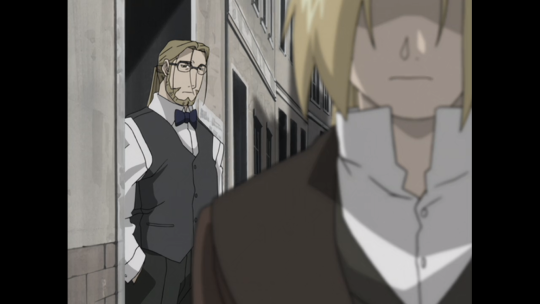
And finally, Hohenheim. He is absent for most of the story. When he finally does show up, he doesn’t offer any excuses for his behaviour, doesn’t really offer them anything at all. When Al is interested in getting to know him, he does spend a bit of time with him, only to leave once more in the middle of night.
Hohenheim is pretty aware of his failings and does attempt to do the right thing in confronting Dante. It goes badly. We do learn that he’s been equally terrible towards Envy, creating the homunculi and then abandoning him to Dante presumably because he saw Envy as a pale imitation of his long dead son.
At the end of the series, Ed is with Hohenheim and he’s forgiven him, it seems. He’s been pacified with the revelation that Hohenheim did love Trisha and is saddened by her death as well so Ed’s let go of some of his hate that was the result of blaming him for Trisha’s death. They’re an odd pair but Hohenheim is trying to at least give Ed the needed support in the new world. I doubt they’re truly close, it’s more that circumstances have pushed them together. Still we do see him giving Ed some advice and encouragement while letting him go seek out his own answers.
And that’s basically all the Fatherly figures in the series barring, like, the innkeeper from Yousewell who was an alright guy, I suppose. And there’s Pride who I guess is a bit of a fatherly figure to his soldiers. Very friendly and personable with that sort of Grandfatherly persona. Yet again, it’s all fake though. He has cultivated this image with a perfect-looking family but he won’t hesitate to strangle his son and start wars.
Er, maybe Armstrong could be read as fatherly? He is kind to the Elrics, taking care of them and worrying over them. I always struggle with Armstrong, I’ll be honest.
–
Yeah and that concludes this post. We’ve got absent fathers and people who pretend to be fatherly and people who fail at it. And we’ve got Hughes who is wonderful. And dead.
Roy is a more morally ambiguous character in 03 compared to his Brotherhood counterpart. We more explicitly see him blowing up children and he is of course responsible for killing Winry’s parents. His attitude towards the Elric brothers was a little colder and he just generally seemed more manipulative. He’s got his good moments too but it comes across more as attempting to be heroic in order to redeem himself rather than a naturally good, heroic person.
Riza’s not explored nearly as much in 03 as in Brotherhood where she gets much more backstory and is more central to the story. One thing that remains consistent is her devotion to Roy though. Her support is unwavering. Never seeing any of her backstory, we’re instead left to wonder at why she trusts him so much.
Because Roy is less obviously a good person, it makes Riza’s unwavering support of him more remarkable because it can be seen more as a character flaw. Her decision to defend his actions really shows how biased her feelings are:
-Refusing to condemn him for killing Winry’s parents even when Winry confronts her about it. Shielding Roy when she confronts him about it.
-Defending (admiring) his actions of using his flame alchemy at that protesting refugee camp to scare people into submitting to the military’s orders.
-Helping him to stage a coup in order to go and assassinate the Fuhrer.
It’s not a bad thing though, indeed she is very aware of all the things Roy has done and the two of them are virtually always together. My personal headcanon would be that Riza feels her own guilt for the deeds she committed in the past and sees Roy as her way of absolving that guilt. His goals are, of course, to change the way the State is run in order to prevent more pointless wars such as Ishval.
Riza’s great. It’s just, they’re not perfect people. She’s very much a loyal soldier who only ever offers any advice or criticism when the two of them are alone. I feel she will defend Roy to the end. It’s admirable but it’s also dangerous because he’s a clearly flawed person.
This is my favourite arc in the series. Ed really gets pushed to his limit here, in multiple ways. There’s a great deal happening but I want to focus on the encounter with the Slicer Brothers and their impact on him.
Okay, episode 20, Ed has a fight with a pair of brothers trapped in a suit of armour. He defeats them though its a close battle and his automail arm nearly breaks. He also sustains two pretty bad wounds in his shoulder and in his side. His vision grows hazy while fighting and he almost loses conciousness due to blood loss. It’s a brutal battle.
But it’s the after match that becomes really interesting. The Slicer brothers ask Ed to destroy them. Ed refuses, stating that he doesn’t want to kill them because he considers them to be human beings to their surprise. His words really have an impact on them.
Unfortunately his words are not enough They are gratified by his sentiments and genuinely begin to respect him, both for his ability to defeat them and for his kindness and respect for their own value as more than objects. But they’re also broken – Ed’s destroyed them such that they can’t even pretend to be human like Al can. And they don’t believe they could be accepted by society, not in their current form and not as the humans they were – murderers. The younger brother chooses death over being trapped in his form. It seems he only coped so long by convincing himself that he was no more than a weapon because he couldn’t live as a human. Therefore, Ed kind words are painful, because they taunt him with an unattainable idea of a better existence, a better life.
Ed is being presented with his worst fears here. That being a soul in a suit of armour is worse than death. That his efforts to help others may hurt them. That even if he didn’t intend for it, he feels partially responsible for their death. That there are no right answers sometimes. That there are no solutions to some things.
Immediately following this, Ed goes deeper into Lab 5 and is confronted with red stones, Enough red stones to create a Philosopher’s stone to save his brother. So shortly after seeing another younger brother kill himself rather than continue living in a suit of armour, Ed cannot help but be desperate to fix his brother. Al has expressed his misery at living as a suit of armour multiple times before and sometimes Ed tried to brush it off and encourage his brother with his promises. But now he cannot ignore it anymore. Here’s the moment where he can make good on his promises. Al cannot continue to live as a suit of armour. Ed assures himself that he won’t let Al go through what happened to the Slicer brothers.
When he looks into the red room, he imagines his brother human again. He’s been so harshly reminded of the promise he made and the consequences of failure.
This is exactly what’s on his mind when faced with a decision to sacrifice a group of people to make the stone. Lust is even threatening to destroy Al’s anchoring seal for extra motivation. (That the Homunculi’s own goal is sympathetic and relateable, to become human too, doesn’t help.) Refusing to act is giving up their quest,
When he realises he can’t do it, he quietly apologises to Al, feeling like his kindness and decency is a weakness. (In the next episode he even believes Al is angry at him for his decision.)

Greed’s death can indeed be considered essentially committing suicide by convincing Ed to kill him. This is basically confirmed by Martel in episode 39. She thinks that Greed wanted Ed to kill him, as that was better than being left with nothing.
The reason he insisted on challenging Ed was, I believe, so Ed could find the strength to kill. He could’ve revealed that Alphonse had already been freed but he let Ed think otherwise and didn’t correct his assumption on him killing Dante.
He wanted revenge on Dante and the Homunculi for what they did to him. Greed had accepted his life was over when he stepped into Dante’s house and he didn’t want to be trapped again. He couldn’t bear the idea of working for her either, what he most valued was his freedom. Challenging Ed and telling him the Homunculi’s weakness was the only thing he could do to give his death any meaning.
The Reflections OVA actually suggests that the reason he wanted to know how to replicate Al’s soul armour for himself was so he could still have immortality without needing to rely on Dante for red stones, allowing him to be free of her. All his actions could be framed in this light, allying himself with powerful alchemists and chimeras (and chimera alchemists) as well as his interest in getting Wrath on his side were to gather enough strength to be free from Dante’s control.That all failed with Envy winning Wrath over and his chimeras companions being killed.
This is a lovely and peaceful episode where Ed and Al go back to Risembool to get repaired before things heat up again when they leave for central. Though it’s a breather, there’s a surprisingly high amount of development in it. It’s got themes of home, family and memories in it.
At the start of the episode, Ed says he’s never been back because they have no home here anymore. They burned it down.
Winry and Pinako are friendly and welcoming throughout the episode, going out of their way to help them. Still, Winry gets angry and frustrated that the brothers can’t seem to get how much they care about them.
Edward is frustrated at his inability to move on from the past, with his watch declaring the date the burned their house down, a constant reminder of his motivations. Winry is frustrated at his approach, struggling to express that their time with them isn’t wasted like Ed believes, because she and Pinako still care about them and there’s more to their life than their tragedy. She starts crying about it, claiming that she’s crying because neither of them will and hates how they’re avoiding dealing with their feelings.
Al’s struggling with his memories and sense of self in this episode, being back in Risembool seems to be uncomfortable for him, especially given he is completely immobile. Ed nearly reveals his worries to him (about whether he blames Ed for everything) but loses his nerve. By avoiding dealing with this now, it’ll become the greater identity crisis later that isn’t resolved until Ed does open up to him. It’s great how Winry is able to see these issues even when she hasn’t seen them in so long. Avoiding coming back to Risembool is of course another symptom of their refusal to deal with their feelings.
During the episode Ed visit’s his mother’s grave, showing some acceptance over her death, reluctant (scared) as he is to visit initially. At the end, they visit the ruins of their house, and remember their past fondly. And in the past Trisha had lit a lantern to remind them to come home. In the present, WInry’s holding a lantern, waiting for them.
By the end, Ed says that he does consider this place home and he’ll come back soon. The visuals are beautiful and sunny, though Winry mentions Ed’s watch again, a reminder of unhappy memories and broken homes.
Sloth is the result of Ed and Al’s human transmutation to bring back their mother in FMA 03. Attempting it cost Ed his arm, leg and his brother.
Almost immediately after defeating Sloth in 03, Ed loses his brother:
(Envy kidnaps Al, taking him over to Dante).
He gets punched in the face with his own right arm. (Courtesy of Wrath, of course.)
And his automail leg stops working, so he can’t stand up on is own.
Just as it cost Ed a great deal to create Sloth, it costs him a lot to destroy Sloth too. Sometimes correcting a mistake costs as much as making the mistake in the first place.
But at least Izumi’s there. She’s not the mother Ed wanted, but she’s there all the same. She helps him to stand up and move forwards. (Except this episode, Goodbye, is the last time Ed ever sees her…
I think it’s kind of cute how when Wrath he has no memories he goes around mimicking others, and by others I mean Edward, who’s the first person he meets.
In his first appearance he’s in shadow and unclothed, shown to be watching the Elrics as they wander about happily. (One of the only times they’re happy and its reminiscing about all the terror they experienced as kids, like getting attacked by wild animals and struggling with hunger…)
Then we seem him again and he’s transfigured himself some clothes. We only see his back and a brief evil smile at this point.
We get a proper look at him at the beginning of the next episode, dressed in a black shirt and shiny black trousers. You can’t see it in this shot but he’s actually got black boots on as well.
Yeah, he’s dressed exactly like Ed, (who isn’t wearing a coat or jacket in these episodes) apart from the automail arm. It’s more difficult to mimic! But that’s the very next thing he tries.
Stone fist, to punch Ed with. (Ed did basically attack him here, it’s totally justified for him to be struggling.)
Wrath doesn’t really hold a grudge at this point. That night, Ed and Al go to interrogate him and Wrath just asks if they could play with him, presumably to have fun like Wrath observed on the island.
(I wish we could’ve seen this whole scene of Ed and Al deciding to play catch the rat. They’re actually having fun of all things.) Anyway, Ed isn’t interested in playing with Wrath and instead decides to upset and frighten him.
The next day Ed and Al go and interrogate/attack Wrath again and he ends up running away. They track him down again and he’s calmed down and they actually attempt to have a reasonable conversation and are almost nice to him. So Wrath opens up to him and asks curiously about their limbs, because clearly the automail arm thing has still been bothering him all this time. It’s funny how he asks this question so naively and yet it’s basically the worst possible question to ask the brothers who have worked out that Wrath’s limbs might be Ed’s.
After this, the military grabs Wrath and he has his fateful encounter with Envy, who is friendly at this point and Wrath regains some memories of the gate and what he is. And for whatever reason, his homunculus outfit strongly resembles Envy’s.
(I love how only one of his arms has a wrist thingy on it. Same with the feet.)
Even with his new memories he still mimicks Ed sometimes. Using the same kind of spear to fight him with and transfiguring his arm into a stone spike, as Ed likes to do.
He even cries when Sloth is killed and Ed doesn’t. Ed states out loud that he feels like Wrath was crying for him. His final act of mimicking Ed is of course getting automail from Winry, specifically the new models she’d been designing for Ed. Plus he and Al can interact, while Ed and Al are separated. Wrath totally stole Ed’s happy ending! He’s not even grateful about it…
It’s a shame that Wrath doesn’t get much of a conclusion to his character in the series proper. He’s still very angry and confused. The best thing about CoS was definitely all the Wrath scenes, they show him being much calmer even if he’s not exactly happy.
In FMA 03, when Ed and Al performed human transmutation they ended up creating a homunculus – Sloth. It might seem a somewhat random choice at first glance. Nothing about Trisha Elric was particularly slothful, indeed she raised Ed and Al alone, giving them tons of care. She doesn’t particularly show any vices in the brief time we get to know her.
But then, the point of Sloth’s character is to show that she is not Trisha Elric. She may look just like her but she was created by Ed and Al. This post is made in order to talk more about Ed and his similarities with Sloth.
A critique I sometimes see of Sloth is that she doesn’t embody her sin very well. None of the homunculi in 03 really embody their sins perfectly though, as they were merely named after the sins by Dante. But like, what is the sin of Sloth? It means laziness, sure. But it’s not just reluctance to do work and the desire for rest. The homunculi in 03 are actually incapable of sleep. Sloth also means not caring about things I.E indifference, apathy. This is mental laziness if you like, and denial and avoiding your problems rather than having the willpower to deal with them are other examples of mental sloth.
The homunculus Sloth is very apathetic. She ruthless, shown to be able to kill people without a second thought if they become an inconvenience. She wants to kill Ed and Al because their existence is making her feel things and she doesn’t want to deal with it any more.
I think that the homunculi in 03 all reflect their creators in some ways. For instance, Scar’s brother was in love and ended up creating Lust. He was a very curious person, learning alchemy despite being an Ishvalan and Lust also seems very curious and knowledgeable. Izumi is a very violent person and she creates Wrath. Ed’s not exactly Slothful – Pride might seem a better fit.
But he and Sloth are alike in some ways. Following the human transmutation, both wake up and are encouraged to join the military – Ed by Roy and Sloth by Dante and Pride. Both join the military, Ed feels guilty about the human transmutation and wants to fix things by restoring his brother, Sloth is troubled by the human transmutation and wants to fix things by becoming human. And so, both of them decide to try and get the Philosopher’s stone, having convinced themselves that it will be the solution to their problems. Sloth’s being manipulated, blindly following Dante. Ed’s also being manipulated by Dante. Neither of them are willing to accept their fates.
One of the big themes of FMA 03 is death. Edward has trouble accepting death. His reaction to hearing Winry’s parents are dead is to suggest bringing them back. At his mother’s grave, he doesn’t cry because he refuses to accept she’s gone and suggests bringing her back. Edward is motivated by this denial, (Pride is another big motivator, believing he’s smart enough to do what no one else has ever managed). Later, Nina’s death really shakes him and his instinctive reaction is to try and bring her back – Mustang very coldly tells him to move on. Ed later tells Rose that she needs to try and move forward too. She had allowed herself to believe that Cornello could bring her dead boyfriend back to life. Rose takes this advice to heart, ironically far better than Ed himself can.
As well as trouble with accepting death, Ed has trouble accepting that he could have created a homunculus. Izumi and Wrath have to spell out exactly how a homunculus is made before Ed can believe they’re created through human transmutation. Even then, he refuses to recognise Sloth. (And he totally can’t miss it, he stares hard at Sloth the first time he saw her and Winry recognises her in a second.) Literally right after Wrath explains how a Homunculus is created, he runs into Sloth. But Ed pretends she’s all she appears to be – the fuhrer’s secretary. Al attempts to bring up this multiple times but each time Ed dismisses him, doing anything to avoid that conversation.
But Ed grows up over the course of the series, he grows more selfless over time, becoming more concerned with problems outside himself and his brother. In Liore, the first time he visited, he is utterly concerned with his own goal and in the end he’s only angry that he didn’t get the Philosopher’s stone for his trouble. He doesn’t even realise that he’s only caused instability and conflict for his actions. On his return to Liore he’s forced to face the consequences of his actions and its also the first time he confronts Sloth. After Liore, he’s got the stone but he doesn’t want to use it anymore. His goal is now to stop the homunculi because they are dangerous creatures who want to start wars and cause much death and despair. Therefore, he goes to Risembool to visit his mother’s grave in order to defeat Sloth.
Sloth doesn’t change, she doesn’t want to change. She doesn’t allow herself to care about others and ultimately she forces Ed and Al into a fight to the death. She can accept nothing else. Only when she’s defeated and there’s nothing else to do does she seem to really care. Maybe she just wants to hurt them with sweet words (she can pretend to be kind very well) but maybe she immediately forgives them and accepts her death. All the homunculi are frightfully accepting of their own deaths actually. Scar called Nina a sin against nature and kills her as a kindness. It seems the homunculi see their destruction in the same way.
After this, Ed goes to face Dante fully accepting that he has a duty to stop her. He forgives his father after Hohenheim explains himself to him. Forgiving meaning accept that Hohenheim regrets much of his past and is trying to do what he can to improve now and letting go of his anger, (Still condemning Hohenheim’s past actions as pretty evil and selfish.) Blaming Hohenheim for Trisha’s death is another symbol of his denial, inability to accept death as a natural part of life. Forgiving him is part of Ed growing up.
His final action is to perform human transmutation to try and save Al. Ed’s changed in some was but his care for his brother is too much a part of him. Still, he accepts it may not work, it may be for naught, but he still has to try and even smiles gently as he performs it, knowing he probably won’t survive.
———–
There’s something admirable about Sloth’s rejection of her former life and wish to realise her actual self. It’s quite feminist even (rejecting the role of a housewife forced on her by other in order to embrace her true self.) Her problems are more her methods and that being in denial is not the same as moving on.
 Zetalial